Search Muzik Blog

Showing posts with label Technology. Show all posts

Wednesday, September 14, 2011

Microsoft unveils its new Windows 8 operating system


Windows 8
Windows 8 has been designed to be used on touchscreen devices


Microsoft has taken the wraps off the next generation of its Windows operating system.
Windows 8 is designed to run on tablet computers, as well as desktop and laptop PCs.

The software, which is due to be released in 2012 will work on the popular ARM-designed low power processors for the first time.

Microsoft has been under pressure to come up with an answer to Apple's iOS and Google's Android platforms.

Unveiling Windows 8 at the Build developers' conference in California, Windows division president Steven Sinofsky declared: "We re-imagined Windows. From the chipset to the user experience."

The system will function through one of two interfaces; a traditional desktop, similar to that seen in previous editions of Windows, and a tablet version, known as Metro.

Metro features larger, chunky controls of the sort that best suit touchscreen use. The current lack of such an input method is widely seen as the reason why few Windows 7 tablets exist.

Microsoft said that it would also be launching its own online marketplace - the Windows Store - to sell downloadable applications.

Chip changes
 
One of the biggest innovations for Windows 8 will be its compatibility with processors designed by ARM holdings.

Chips based around the ARM architecture typically use very little power, and as a result are found in the vast majority of smartphones and tablets currently available.

To date, Windows devices have required Intel or Intel-compatible processors, with the exception of Microsoft's Windows Phone range.

ARM chips are likely to be predominantly used on Windows 8 Metro devices, and will require ARM-specific versions of applications.

The company has not given details on the chips that will be integrated into desktop and laptop machines.
Tapping into any section of the Windows market will be seen as a huge boost for Cambridge-based ARM Holdings.

The company faces growing competition in the mobile device sector since Intel launched its tablet and smartphone-focused Oak Trail chipset in April 2011.

Tapping into that particular market is seen as vital for hardware manufacturers, and software-makers, such as Microsoft, as the market for traditional computers continues to be eroded.

Industry analysts Gartner predicted in April that the global market for tablets would reach 70 million this year, and grow to 300 million in 2015.

Sales of desktops and laptops are expected to continue growing, but at a much slower rate than in the past.

Wednesday, August 31, 2011

Tony Sale, Colossus computer conservationist, dies

Tony Sale built a working robot out of scrap from a crashed bomber
Tony Sale, the brilliant engineer who led the rebuild of Colossus, the first modern computer, has died aged 80.

The mammoth project to recreate the code-cracking Colossus capped a career built around electronics and computers.

Most recently, Mr Sale drove the campaign to save Bletchley Park, where Colossus aided Allied code-cracking efforts during World War II.

At Bletchley he also founded the National Museum of Computing to help preserve the UK's ageing computers.

Born in 1931, Mr Sale displayed his talent for engineering at an early age by building a robot, called George I, out of Meccano. One of the later versions of George was built from the remains of a Wellington bomber.

Instead of going to university, Mr Sale joined the RAF, which nurtured his engineering talent, and by the age of 20 he was lecturing pilots and aircrew about advances in radar.

His career also included a six-year stint as a scientific officer at MI5. He rose to become principal scientific officer of the intelligence agency and aided the work of spycatcher Peter Wright. On leaving MI5 he established, ran and sold a variety of software and engineering firms.

During the late 1980s Mr Sale's job at the Science Museum nurtured an interest in old computers. This led to the creation of the Computer Conservation Society which leads efforts to restore many key machines. 

His interest led to the 14-year project that saw the re-creation of the pioneering Colossus computer. During wartime, Colossus gave the Allies an insight into the communications of the German high command.

The rebuilding work was difficult because the original Colossus machines were broken up at the end of WWII and all plans for it were destroyed.

The rebuilt Colossus became the centrepiece of The National Museum of Computing (TNMOC) that Mr Sale established at Bletchley Park.

"Tony Sale's passing is a tremendous loss to us all on a personal and professional basis," said Andy Clark, chairman of the TNMOC trustees.

"Tony's contributions to The National Museum of Computing have been immense and I am quite sure that without his remarkable talents, enthusiasm, and drive, the museum would not have come into existence," said Mr Clark.

Thursday, August 25, 2011

Why Apple without Steve Jobs is no fun


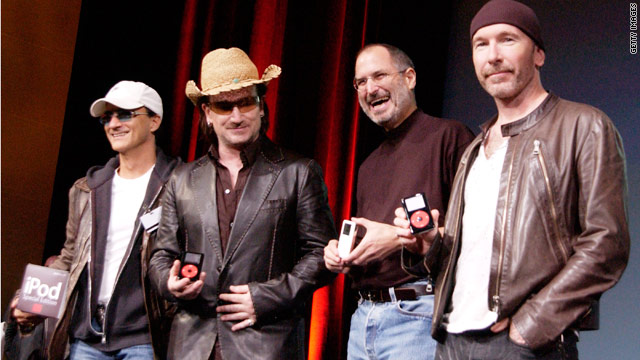
Steve Jobs, third from left, and members of the band U2 celebrate the launch of an Apple iPod in 2004.Now that Steve Jobs has stepped down as CEO of Apple, many people in the tech and business worlds are wondering what will become of the world's largest tech company, which brought us the first personal computer and the first for-real smartphone and ushered in the era of digital music.

Most of that talk centers on buttoned-up topics like market potential and future product lines. What does Jobs' departure mean for the future of Apple's business? For the next iPhone? 

Blah to all that. Perhaps the bigger deal for a tech lover's psyche is this sad little fact: Without Steve Jobs, Apple is far less fun.
The reasons for this are wide-ranging. 

Part of it has to do with Apple's origin story, which, as an excellent episode of "This American Life" explains, is a really big deal to Americans, who love to know where people came from -- especially if they came from relatively humble beginnings and made it big. 

That's true for Jobs, who got a summer job at Hewlett-Packard after he phoned William Hewlett asking for electronic parts he needed for a class project. He went on to found Apple in 1976 in his parents' garage with the help of friend Steve Wozniak. The first product they sold, the Apple-1, was the first personal computer that didn't come as a set of parts that had to be welded together by its owner -- and is credited as the first truly "personal" computer. This underdog theme followed Jobs for his entire career.

"In recent years, Jobs has battled with a rare form of pancreatic cancer -- adding to an epic life story that mirrors the story of Apple itself: ever the underdog, ever the spectacular success," said a post about Jobs on TED.com.

But Jobs' failures are part of what make him a cult hero, too. 

Jobs famously dropped out of Oregon's Reed College. But he later would say that a class he audited in calligraphy inspired Apple's design aesthetic.

He was booted from Apple in 1985. But, while away from the company, he founded a company called NeXT that developed an early version of what would become the revolutionary Macintosh computer operating system.

Jobs chewed on these points during a speech in 2005.

"You can't connect the dots looking forward; you can only connect them looking backwards. So you have to trust that the dots will somehow connect in your future," he said in a commencement address at Stanford University. "You have to trust in something -- your gut, destiny, life, karma, whatever. This approach has never let me down, and it has made all the difference in my life."

All this adds up to people seeing Jobs as an inspiration.

"It is truly the end of an era. Thank you for inspiring us all Steve," Dave Morin, founder of an app called Path and a former Apple and Facebook employee, wrote on his Google Plus page on Thursday morning. "You've shown an entire generation what is possible with innovation, design, and focus."

That kind of impact makes it difficult for anyone else to bring so much history and charisma to the company. In the short time since Jobs' resignation, tech pundits have been writing that the first era of personal computing is over, since Bill Gates from Microsoft and Jobs are no longer in the business.

There's much praise online for the new CEO of Apple, Tim Cook, who has been the company's COO, essentially running it since Jobs went on medical leave in January. A lot of attention is paid, in particular, to his business sense.

At The Atlantic, Nicholas Jackson writes that picking Cook as the next CEO of Apple is "Steve Jobs' greatest creation."

"Tim Cook is not Steve Jobs," he writes. "But he did learn from the best how to emulate him. And if he was going to fail, he already would have. Cook has been acting CEO of Apple since January, when Jobs went on his third medical leave from the company. Yes, it was that long ago. He presided over the latest Mac refresh, over the launch of the iPad 2, over the announcement of the iCloud, and even over that moment, about two weeks ago, when Apple's market cap exceeded that of oil-services giant Exxon, making it number one."

But no one is arguing that Cook will bring as much life to the tech world.

Fortune's Miguel Heft writes:
"Like Jobs, Cook is a relentless executive and exacting boss, a perfectionist who obsesses over minute details. But the similarities between the two men end there. While Jobs is a charismatic leader known for outbursts of temper, Cook, who was raised in a small town in Alabama, is soft-spoken, reserved and intensely private. 

And as Jobs used his creative genius and vision to conceive and design blockbuster products like the iMac, iPhone and iPad, Cook's considerable operational skills were focused on making sure that Apple could build millions of those products and deliver them to every corner of the world to meet customers' seemingly insatiable demand."

The Washington Post says it's "unlikely (Cook will) match the innovative momentum of his predecessor."

Finally, Apple's product announcements -- which are treated like rock concerts by the plaid-shirt-and-big-glasses-wearing tech bloggers who get to attend them -- will be far less theatrical without Jobs' presence.

"Critics often talk disparagingly of the 'reality distortion field' generated by the Apple boss: his ability to convince onlookers that technologies that would seem unformed in other hands have reached a peak of perfection at Apple," the Financial Times wrote. 
"Generating this suspension of disbelief is essential to stirring up demand for gadgets most consumers had no idea they needed, and is an art form of which Mr. Jobs has long been the acknowledged master." 

Cook's commencement address at Auburn University last year gives some hints about his presentation skills.

During the talk, a robe-wearing Cook discussed his decision to come to Apple at a time when the company was doing far worse than competitors.

"Not only was Compaq performing much better than Apple, it was headquartered in Texas, and therefore closer to Auburn football," he said, trying to appeal to the presumably football-crazed audience.
The response to his joke? An un-Steve-Jobs-like silence.